Canonical Correlation Analysis
Canonical Correlation Analysis (CCA) is a statistical analysis technique to identify correlations between two sets of variables. Given two vector variables X and Y, it finds two projections, one for each, to transform them to a common space with maximum correlations.
The package defines a CCA type to represent a CCA model, and provides a set of methods to access the properties.
Properties
Let M be an instance of CCA, dx be the dimension of X, dy the dimension of Y, and p the output dimension (i.e the dimensio of the common space).
-
xindim(M)¶ Get the dimension of
X, the first set of variables.
-
yindim(M)¶ Get the dimension of
Y, the second set of variables.
-
outdim(M)¶ Get the output dimension, i.e that of the common space.
-
xmean(M)¶ Get the mean vector of
X(of lengthdx).
-
ymean(M)¶ Get the mean vector of
Y(of lengthdy).
-
xprojection(M)¶ Get the projection matrix for
X(of size(dx, p)).
-
yprojection(M)¶ Get the projection matrix for
Y(of size(dy, p)).
-
correlations(M)¶ The correlations of the projected componnents (a vector of length
p).
Transformation
Given a CCA model, one can transform observations into both spaces into a common space, as
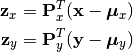
Here,  and
and  are projection matrices for
 X and Y;  and
and  are mean vectors.
This package provides methods to do so:
-
xtransform(M, x)¶ Transform observations in the X-space to the common space.
Here,
xcan be either a vector of lengthdxor a matrix where each column is an observation.
-
ytransform(M, y)¶ Transform observations in the Y-space to the common space.
Here,
ycan be either a vector of lengthdyor a matrix where each column is an observation.
Data Analysis
One can use the fit method to perform CCA over given datasets.
-
fit(CCA, X, Y; ...)¶ Perform CCA over the data given in matrices
XandY. Each column ofXandYis an observation.XandYshould have the same number of columns (denoted bynbelow).This method returns an instance of
CCA.Keyword arguments:
name description default method The choice of methods:
:cov: based on covariance matrices:svd: based on SVD of the input data
:svdoutdim The output dimension, i.e dimension of the common space min(dx, dy, n)mean The mean vector, which can be either of:
0: the input data has already been centralizednothing: this function will compute the mean- a pre-computed mean vector
nothingNotes: This function calls
ccacovorccasvdinternally, depending on the choice of method.
Core Algorithms
Two algorithms are implemented in this package: ccacov and ccasvd.
-
ccacov(Cxx, Cyy, Cxy, xmean, ymean, p)¶ Compute CCA based on analysis of the given covariance matrices, using generalized eigenvalue decomposition.
Parameters: - Cxx – The covariance matrix of
X. - Cyy – The covariance matrix of
Y. - Cxy – The covariance matrix between
XandY. - xmean – The mean vector of the original samples of
X, which can be a vector of lengthdx, or an empty vectorFloat64[]indicating a zero mean. - ymean – The mean vector of the original samples of
Y, which can be a vector of lengthdy, or an empty vectorFloat64[]indicating a zero mean. - p – The output dimension, i.e the dimension of the common space.
Returns: The resultant CCA model.
- Cxx – The covariance matrix of
-
ccasvd(Zx, Zy, xmean, ymean, p)¶ Compute CCA based on singular value decomposition of centralized sample matrices
ZxandZy.Parameters: - Zx – The centralized sample matrix for
X. - Zy – The centralized sample matrix for
Y. - xmean – The mean vector of the original samples of
X, which can be a vector of lengthdx, or an empty vectorFloat64[]indicating a zero mean. - ymean – The mean vector of the original samples of
Y, which can be a vector of lengthdy, or an empty vectorFloat64[]indicating a zero mean. - p – The output dimension, i.e the dimension of the common space.
Returns: The resultant CCA model.
- Zx – The centralized sample matrix for